Gardening in north Orange County, California

Wednesday, September 14, 2016

Praying mantis


I saw this mantis as I was sweeping the driveway this morning -- thought it was a stick my broom had missed and was about to pick it up when it started to walk away!  It was very sluggish and crawled up the leg of this pot instead of flying, but it is a cool and overcast morning, so perhaps the mantis just hasn't warmed up yet.

The mantis is generally a beneficial insect, eating flies, mosquitoes, crickets, aphids, etc., but being a voracious carnivore it will also eat other beneficial insects, including other mantises.

Saturday, September 10, 2016

Brown marmorated stink bug


We caught this in the house this afternoon -- identified it as a brown marmorated stink bug (Halyomorpha halys). Yuck.

Apparently this bug, accidentally imported from Asia in the 1990s, is now a serious pest, with a website with some pretty big names attached to it dedicated to controlling it. More advice from Penn State is found here.  The bugs feed on soft-skinned fruits such as apples, peaches, grapes, etc. disfiguring the crops and making them unsellable, and the stinky secretion they produce when threatened can cause allergic reactions in humans.

Saturday, July 25, 2015

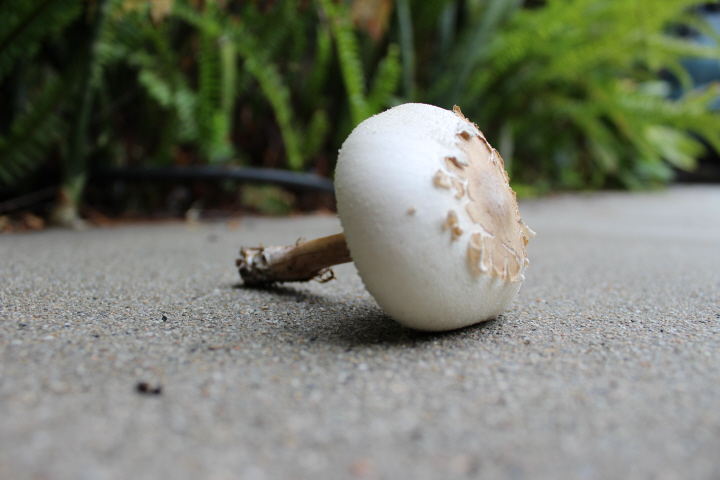
False parasol mushroom


The false parasol (Chlorophyllum molybdites) is a very common and very toxic mushroom, often found in Southern California lawns.  Because its appearance is similar to the edible parasol mushroom, and because it is so often found in lawns, it is one of the most commonly-consumed poisonous mushrooms in North America. Apparently it will not kill you if eaten, but will make you very uncomfortably sick, with vomiting and diarrhea, so is best avoided altogether.

Interestingly, when I picked the mushroom, it looked like this,


and by the next morning the cap had opened and spread to this,


The brown scales had also begun to flake off -- it often looks like this while growing.

The ruler I used was not the best for this lighting, obviously -- this particular mushroom is about 4 inches (10cm) long, but can be found larger or smaller.


A distinctive characteristic of the false parasol is the greenish spores, which are beginning to be apparent in the photo, and came out quite clearly in the spore print I made -- the name "chlorophyllum" comes from the Latin chloro, green, + phyllum, gills.


For further reference, and other pictures to help you identify this toxic mushroom, see the Wikipedia article "Chlorophyllum molybdites", Tom Volk's "Fungus of the month" for August 1999, the C. molybdites pages at California Fungi and Urban Mushrooms.

Sunday, May 31, 2015

Bushtit's nest


We noticed this bird's nest in the honeysuckle growing over a chain-link fence in our garden this afternoon.  The nest is about 8 in. long (20cm), and about the size of a grapefruit or large apple at the bottom.  You can clearly see the opening near the top of the nest in the photo above and the next one.

There is an old Bearss lime tree with low-hanging branches above, but the nest is actually in the tangle of honeysuckle, a little less than five feet off the ground.  It is constructed of twigs and leaves and various garden rubbish, including bits of newspaper that we put down as mulch a few months ago, and possibly a piece of pink dryer lint! It is probably a bushtit's nest, but we haven't seen any occupants yet.


The photos are all full-size --


This is the back of the nest, which is on the other side of the chain-link fence.


Saturday, April 25, 2015

Tall fescue


I thought this was one of the numerous crabgrasses, but apparently it is tall fescue (Festuca arundinacea). The crabgrass seed heads, as far as I can tell, all have that distinctive splayed-tines formation, while these stay quite close to the stem.  Yes, that's my shovel at the bottom of the photo! it's a weed in our yard.

The seedlings of crabgrass and fescue look remarkably alike.


Friday, April 24, 2015

Thursday, January 29, 2015

Rosa "Duchesse de Brabant"


This was apparently one of Theodore Roosevelt's favorites, often wearing it as a buttonhole. Perhaps it grows differently here in southern California, as it has very little scent and the blooms last only a few hours once cut, so not the ideal boutonnière here.  On the other hand, it grows enthusiastically with very little attention or water, and the loose blooms are really charming. In my garden, it is usually paler than this deep pink, but it enjoyed the recent rains!